
Sub-Total: $0.00
How to Style Statement Jewelry
Bold lines. Quiet confidence. Jewelry that speaks without shouting.

Statement jewelry works best when it has room to speak. A sculptural necklace, expressive pair of earrings, or distinctive ring can transform even the simplest outfit, but the most memorable styling rarely comes from wearing everything at once.
The key is intention. Consider where you want the eye to travel, how the jewelry relates to the silhouette of your clothing, and which details deserve to take the lead. When those elements work together, statement jewelry feels personal and refined rather than overly styled.
Choose one focal point first
Begin by deciding which piece should command attention.
If you are wearing dramatic earrings, give them space around the face and neckline. A clean collar, open neckline, or softly swept back hair allows the shape and movement of the earrings to become part of the overall silhouette.
A distinctive necklace works differently. It often benefits from a quieter garment underneath, especially when the piece has strong geometry, layered chains, stones, or sculptural detail. Think of the clothing as a backdrop rather than a competitor.
The same principle applies to rings and bracelets. One substantial piece can have greater impact than several pieces fighting for attention. The goal is not necessarily minimalism. It is clarity.
Consider scale and proportion
Statement jewelry has visual weight, so scale matters.
Larger earrings naturally draw attention toward the face. A substantial necklace can broaden the visual area around the neckline, while a stack of bracelets adds movement and interest near the hands.
Consider those proportions alongside the clothing you are wearing. A strong necklace can balance a simple sweater or structured jacket, while oversized earrings may be all that is needed with a fluid blouse or open neckline.
Sleeve length matters too. Bracelets and cuffs are easier to appreciate when they are not competing with heavily detailed sleeves. Rings become more noticeable when the rest of the hand and wrist styling is restrained.
The jewelry does not need to match the scale of the clothing exactly. Contrast can be beautiful. What matters is that the relationship feels deliberate.
Let the neckline guide the necklace
Necklines create a natural frame for necklaces.
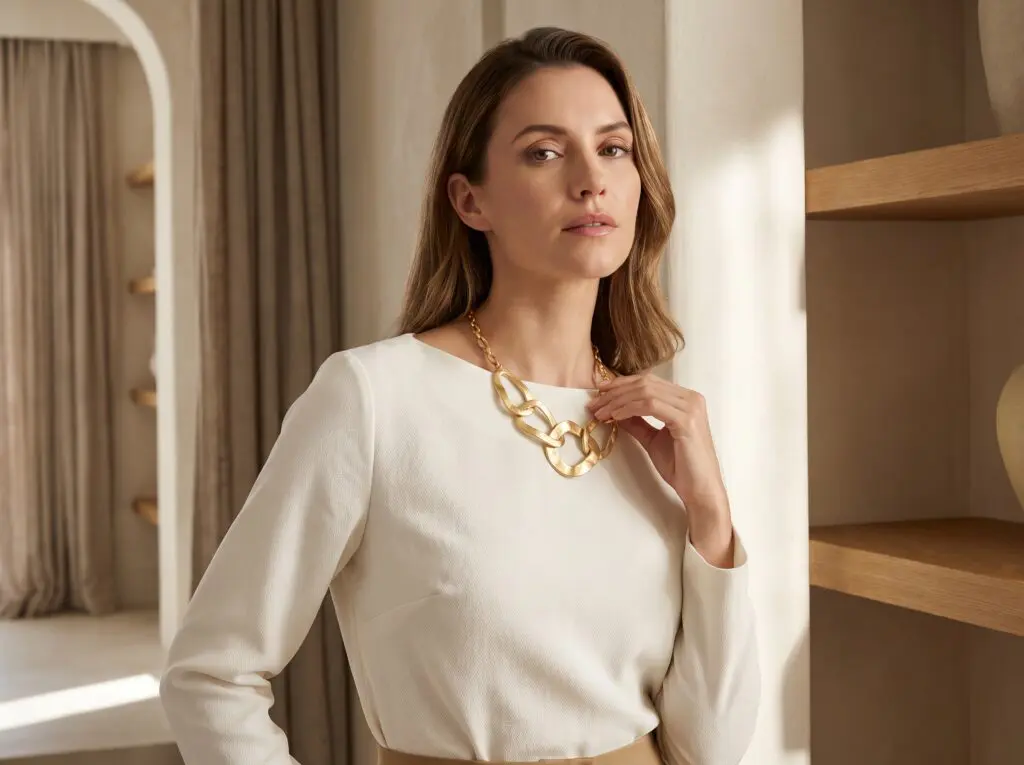
A V neck can echo the line of a pendant or longer chain, drawing the eye downward and creating a clean sense of proportion. Crew necks provide a simple canvas for shorter statement necklaces that sit clearly above the fabric.
Open collars and button downs can work beautifully with layered chains or a single sculptural piece worn against the skin. With higher necklines, consider whether the necklace should sit over the garment or whether earrings would make the stronger statement instead.
There is no single correct formula. The most successful combinations simply allow the necklace and neckline to complement rather than interrupt one another.
Balance statement earrings with the rest of the look
Expressive earrings have an advantage: they naturally frame the face.
When earrings are large, architectural, or richly detailed, keep nearby jewelry quieter. A delicate necklace or no necklace at all can allow the earrings to remain the focal point.
Hair can also change the effect. Hair worn up or tucked behind the ears gives the jewelry greater visibility, while loose hair creates a softer glimpse of movement and shine.
This does not mean every other accessory must disappear. A refined ring or bracelet can still complete the look without competing for the same visual territory.
Mix metals with intention
Mixing gold, silver, and other metal tones can look sophisticated when the combination appears purposeful.
One simple approach is repetition. If you wear a gold necklace with silver earrings, introducing another small gold detail through a ring or bracelet can make the mixture feel connected rather than accidental.
You can also let one metal dominate while another acts as an accent. The contrast often feels especially modern when the jewelry shares another common element, such as similar shapes, textures, or proportions.
There is no need to match every metal perfectly. Cohesion matters more than uniformity.
Use clothing as a quiet backdrop
Statement jewelry often looks strongest when the clothing beneath it provides breathing room.
Cashmere, linen, silk, fine knits, and clean tailoring offer texture without competing for attention. Neutral colors can be particularly effective because they allow metal, stone, and shape to become more noticeable.
That does not mean statement jewelry belongs only with simple outfits. A richly colored garment or subtle print can work beautifully when the jewelry repeats a tone or complements the overall silhouette.
The goal is balance. If the clothing already carries considerable visual detail, choose jewelry that adds definition rather than another layer of noise.
Create a personal signature
The most compelling jewelry is rarely chosen only because it is fashionable.
A necklace worn repeatedly with different outfits, a pair of earrings that instantly feels like you, or a ring that becomes part of your everyday routine can develop a presence far beyond a single look.
These are often the pieces people remember.
Personal style becomes more distinctive when certain details return again and again. Perhaps it is sculptural gold, black onyx, mixed metals, oversized hoops, or a particular type of chain. Repetition turns preference into signature.
Know when to stop
Statement jewelry does not require restraint for restraint’s sake, but it does benefit from editing.
Before leaving the mirror, consider whether every piece contributes something meaningful. If two elements are competing for the same attention, remove one and look again.
Often, the final edit is what allows the strongest piece to become truly noticeable.
Jewelry should feel collected rather than crowded, expressive rather than excessive.
And above all, it should feel like yours.